Which way to turn nut to remove u bend

Joined
8 May 2016
Messages
46
Reaction score
2
Country
United Kingdom
Hi all,

Dumb question incoming so apologies. I got to clear out my u bend in the bathroom sink as water flows away really slow.

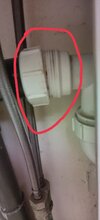
In the attached picture which way do I turn the nut to loosen it. Am I right in thinking it's to the right as opposed to the left.

I've had a go both ways but not too much.
 

Attachments

  • IMG_20250421_234148.jpg
    IMG_20250421_234148.jpg
    119.2 KB · Views: 73
it looks cross threaded and that's why it is probably jammed - its been put together by an idiot

It is all Right hand thread, so the nut will come off by turning it anti-clockwise - it will turn you will just have to try harder
 
Thanks, it does move both ways so not jammed but turning it right it just goes round and round. but I can see what you mean it looks at an angle no idea what's happened there. But there is a bit of water coming from it sometimes. Think it needs replacing?
 
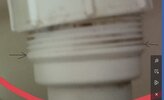
If you're ever wondering this and you can see the screw thread, look at it closely:

1745299416619.png


You see where I put the black arrows? That part of the thread tells you which way the thread runs. I'll just rotate the image to make the next part easier to explain:

1745300300425.jpeg


So imagine the thread as like a very slight hill, and if you got your fingernail and followed the thread "up hill" (from left to right in the rotated image, from bottom to top in your image), round the back, carry on, round the front, keep going round and round, your nail will eventually come out of the thread

The plastic ring that is presently screwed on needs rotating in the same uphill direction as your nail travels, so it must be turned so the front is travelling upwards

As it's badly cross threaded it might be that either one of the threads is ruined so you'll probably also need to exert some effort pulling the ring leftwards while you rotate it upwards. I dare say it's really near the end of the thread anyway and about to come off so you may find it all just comes apart with some determined pulling/twisting/levering

Rotate in the direction of the black arrow while also pulling/forcing in the direction of the blue:

1745300105251.png


Make sure you protect yourself so if it all suddenly slips apart you don't bash yourself on anything sharp under the sink

I dare say it's ended up the way it has because the angle on the black pipe meeting it is poor; it should form a more straight connection and make it easier to get the sealing washer pressed into place

When you get this apart you should ideally find the thing you turn, a plastic washer and a sloping rubber washer (in that order on the black pipe from left to right) with the thickest part of the rubber washer next to the plastic washer . When all assembled nicely and straight the thing you turn should press on the plastic washer which pushes the sloping washer into the gap between black pipe and white receptacle


1745300786244.png


Probably some careful reassembly will be enough to see you right, as is it likely leaks because the seal at the top is poor due to the cross threading and letting a lot of water down the sink floods it up enough to leak past

 

Attachments

  • 1745299624409.jpeg
    1745299624409.jpeg
    72.9 KB · Views: 28
Last edited:
If you're ever wondering this and you can see the screw thread, look at it closely:

View attachment 379633

You see where I put the black arrows? That part of the thread tells you which way the thread runs. I'll just rotate the image to make the next part easier to explain:

View attachment 379636

So imagine the thread as like a very slight hill, and if you got your fingernail and followed the thread "up hill" (from left to right in the rotated image, from bottom to top in your image), round the back, carry on, round the front, keep going round and round, your nail will eventually come out of the thread

The plastic ring that is presently screwed on needs rotating in the same uphill direction as your nail travels, so it must be turned so the front is travelling upwards

As it's badly cross threaded it might be that either one of the threads is ruined so you'll probably also need to exert some effort pulling the ring leftwards while you rotate it upwards. I dare say it's really near the end of the thread anyway and about to come off so you may find it all just comes apart with some determined pulling/twisting/levering

Rotate in the direction of the black arrow while also pulling/forcing in the direction of the blue:

View attachment 379635

Make sure you protect yourself so if it all suddenly slips apart you don't bash yourself on anything sharp under the sink

I dare say it's ended up the way it has because the angle on the black pipe meeting it is poor; it should form a more straight connection and make it easier to get the sealing washer pressed into place

When you get this apart you should ideally find the thing you turn, a plastic washer and a sloping rubber washer (in that order on the black pipe from left to right) with the thickest part of the rubber washer next to the plastic washer . When all assembled nicely and straight the thing you turn should press on the plastic washer which pushes the sloping washer into the gap between black pipe and white receptacle


View attachment 379637

Probably some careful reassembly will be enough to see you right, as is it likely leaks because the seal at the top is poor due to the cross threading and letting a lot of water down the sink floods it up enough to leak past
What a great response and really helpful. Thank you. So actually in my imagine going up is actually loosening it? Or in your rotated image turning right.

It's been like this for years it was only last few months sink has got a blocked and examining revealed this. I'll have a go. Cheers.
 
Yes going up is loosening it. It's badly cross threaded and needs to be undone then carefully reassembled to fix.

You should align the black pipe to be as straight as possible when reassembling:

1745304049012.png

(I've underlined the angle of the black pipe in orange pen and the angle of the white pipe in pink pen; lift and twist the black pipe to get it straighter. You might also need to try flexing the entire white thing to the right, bending it so gently to try and improve the alignment)


carefully screw everything together (once crossed, threads are easier to re-cross on subsequently reassembly attempts) keeping the rotating plastic collar square with the threads (able to see the same number of threads at the top as you can at the bottom)
 
Loosen the ring at the other end of that elbow and only tighten them both when they have both gone on at least a couple of turns.
 
Last edited:
Take that part off the trap, as suggested, left and right nut in the pic and take it out, imagine the fitting was off and you were looking at that nut fitting end on, then it's lefty loosey/righty tightey.

Once it's off take the nut, seal and washer out of the fitting and then try just the nut on again, if the nut goes back on nice and square and easily it can be re-used, if it doesn't then time to replace the trap.
 
Last edited:
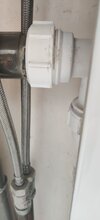
Thank all for your help for it rectified today. The amount of stuff in the entire p trap was unreal. Solid too. I also can't believe how unscrewed the whole drain to pipe was.
 

Attachments

  • IMG_20250422_175533.jpg
    IMG_20250422_175533.jpg
    100 KB · Views: 42
Yeah it might have only been years of gunge that was providing a seal!

It's also easy to see when you multiply what you found by the tens of millions of homes in Britain, how the sewers end up with accumulations of fats that size of double decker buses, blocking them up.

The water board's recent adverts to bin used cooking oils etc seem to have had no effect on my mother in law, who openly admitted some months back that when she's done cooking a pan's worth of beef burgers and has a huge amount of exuded fat lolling about in the pan she just swills it round with some hot soapy water and tips it down the sink. My note that it doesn't stay hot, and hence liquid, for long seemed to fall on deaf ears so I tried an experiment, doing exactly that with left over fats, but pouring them into a clear plastic bottle instead of the drain, adding soapy water, shaking and letting it cool. After a few days of this bottle sitting on the sideboard her curiosity got the better of her and she asked what the lump of white slime stuck to the side of the bottle was..

I always thought that the soap would do a reasonable job of keeping the fats dissolved in the water, as that's how it works from a scientific viewpoint, but I think the quantity of soap needed to do so is actually quite considerable, far more than a person would think reasonable to use, so we've started trying to be kinder to our drains and I've set a hard rule that anything with cooking fats in needs to be drained (we keep a Pringles can in the freezer to drain used fats into) and then wiped out with tissue that is binned, before being washed, but it's a massive faff.. And I can't think of an easy way to improve it
 

If you need to find a tradesperson to get your job done, please try our local search below, or if you are doing it yourself you can find suppliers local to you.

Select the supplier or trade you require, enter your location to begin your search.


Are you a trade or supplier? You can create your listing free at DIYnot Local

 
Back
Top