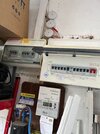
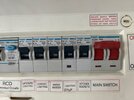
We can have current going live to earth this is an earth fault, and current going between the lives, i.e. line to neutral and up to a set figure this is normal, and over the set figure it is a fault.
We have to test it will trip the protective devices, and we use a loop impedance meter for this, it varies depending on the protective device so a B32 MCB needs to pass more than 32 x 5 amps = 160 amps to trip the magnetic part, we often test the line - neutral in amps called the prospective short circuit current (PSCC) and the line - earth in ohms called the earth loop impedance (ELI) but the two are interlined with ohms law so 230/160 = 1.44Ω to allow for volt drop we give a 5% margin so 1.38Ω is the pass mark.
Where we don't have a TN supply, often the ELI is not good enough to trip the magnetic part of an MCB, so we have to use an RCD as well. But we realise that over 200Ω an earth rod can be unstable, so although it would trip with a much higher ELI we consider 200Ω to be the limit.
The BS7671 has tables, and for a fuse these are the only method,
this may have changed as from the 2008 version, so for 3 amp fuse ELI has to be under 16.4Ω, but for an MCB it can be calculated, and the student can better understand where these figures come from when shown the calculation.
In my early years, I made a mistake, I was using MCB's for 110 volt supplies, and I had not considered what earth loop impedance would be required to trip them, so a B16 so 80 amps to trip the magnetic side of the trip, at 55 volts to earth, so ELI needs to be 55/80 = 0.68Ω also of course we have line 1 and line 2, no neutral, so MCB has to be two pole, there were a lot of fires with 110 volt supplies because they did not trip with a short circuit.
The cause of building site fires is often the yellow brick transformer, with has the trip on the supply not the output, so 10 amps at 230 volts = 42 amps at 55 volts and 1.5 mm² cable will not take 42 amps. Here endesth the lesson for today.